
Novalis
sexy poems part 4

An Eternal Siesta in Sophia’s Breast: Thoughts on the Immortality of Erotic Ecstasies
(Is that title too long? Haha)
~*~
Sources:
The Ascent, The Culturalist, Jonathan Pageau, Michael Martin’s The Submerged Reality: Sophiology and the Turn to a Poetic Metaphysics & Meditations in Times of Wonder
///
To understand Novalis, you must first redefine the word “erotic” in your brain.
Erotica is originally the term used for literature that celebrates a specific form of love called Eros. It is often misunderstood as lust. “Generative energy and love that overcomes reason” would be a better definition.
You can feel Eros towards anyone and it doesn’t have to involve sex— examples are God, your baby, your platonic friendship (pun intended!)
A word on Plato:
His Symposium describes Eros as “a spiritual yearning for beauty, goodness, and creation…a desire that pulls the soul toward higher truths and eternal beauty.”
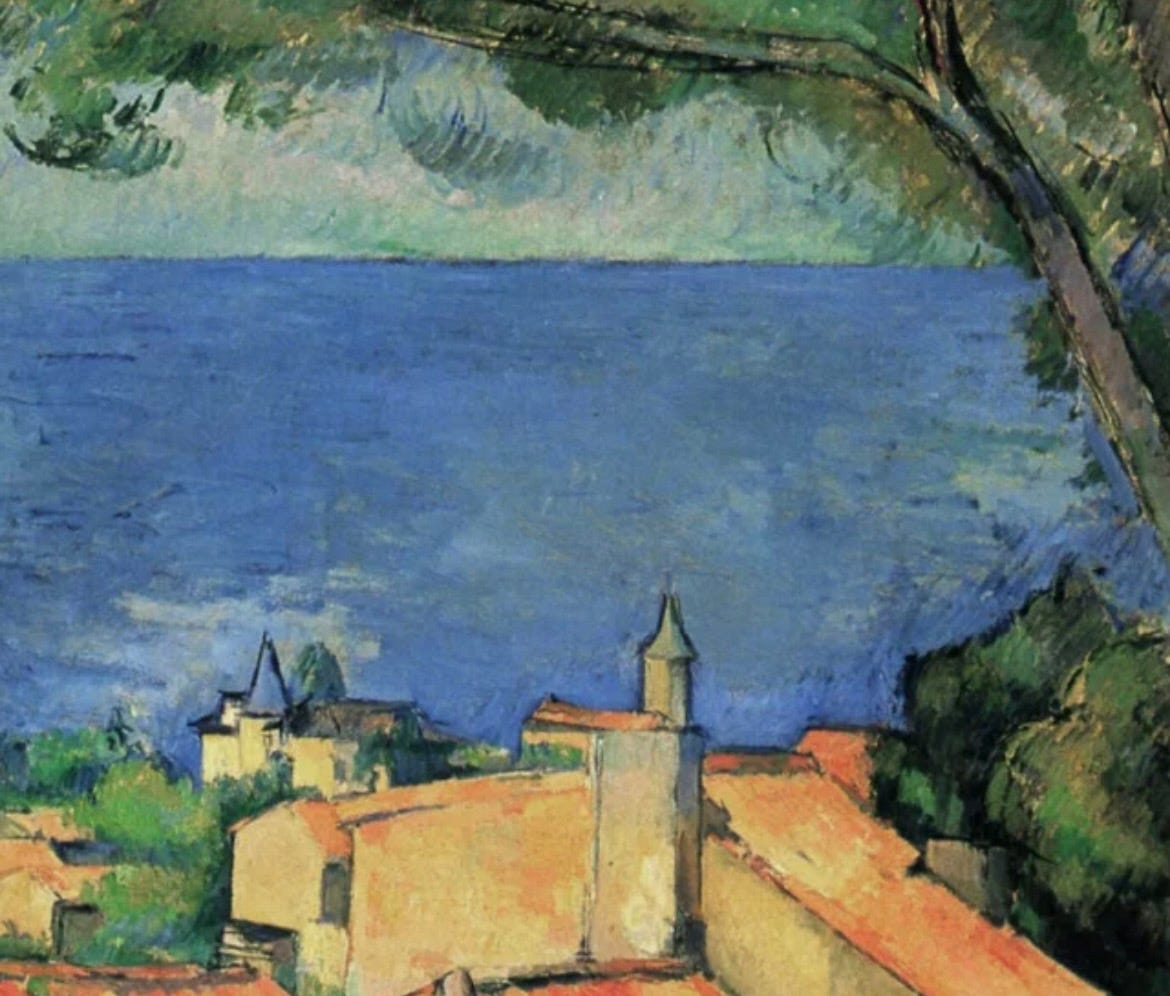
Don’t you feel it when you see a Cézanne?
5 Types of Love
Whereas “storge” is love without choice, like loving the tree you grew up with in your backyard simply because it’s there— or loving your postman simply because you see him everyday— “philia” involves supreme freedom and agency, “agape” takes radical action, “philautia” underpins them all with dignity/ boundaries, and “eros” is the energy drawing you in, a longing to be known by another authentically, and the holy craving of delight in beauty.
***
Oh, the complexity of all the loves! The purpose of categorizing them is not to limit your relationships but to facilitate discussion and awareness. In fact, most of them overlap. There is “philios” in my marriage, for example, and I feel “eros” towards my kids, etc. Ultimately we can give thanks to God for making our souls so intricately woven.
But my! How poorly misunderstood is Eros— if we dilute “Desire for intimacy” to marital relations or exclude it to couples, something is sorely lacking in our souls.
Feel free to comment or discuss:
—How do you express your longing to be seen? What about your yearning for beauty?
—Name some souls who crave your attention and witness. How do they express the desire to be known? Is it reciprocal?
—What are some misconceptions you have about the word “erotic”?
—How do you hope to grow in your ability to love erotically?
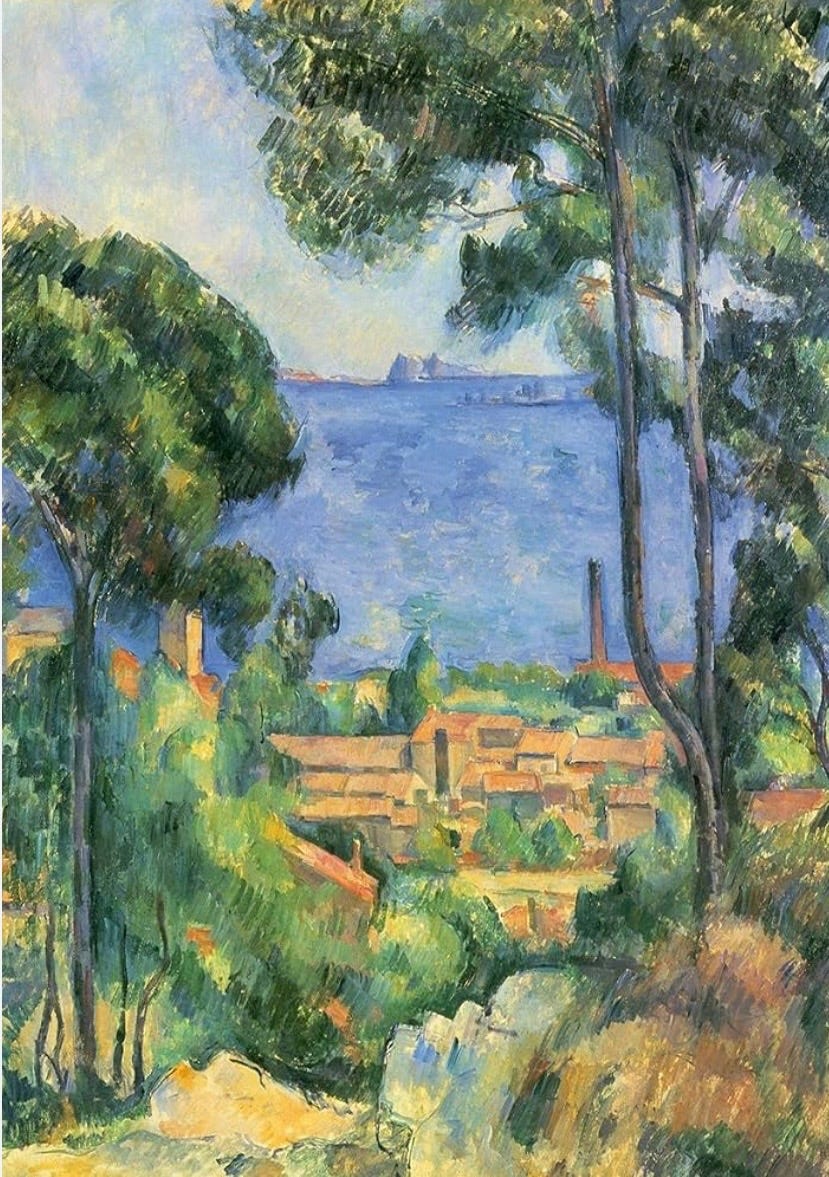
More Cézanne.
***
Is that enough preamble?
The Poet Himself
Let’s get to know our poet!
Novalis (thankfully he gave us an easier name than his real one, Georg Philipp Friedrich Freiherr von Hardenberg) was a Catholic philosopher who lived from 2 May 1772 to 25 March 1801.
The highlight of his short life was falling in love.
Novalis met Sophie when he was 22 and she was 12. He fell instantly in love.
Three years later, her death. Then three more years, he died. (If you like sad stories, read Blue Flower by Penelope Fitzgerald.)
***
Here are some bullet points on his philosophical leanings before we bounce into the sexy bits:
—Fragmentism: art in a state of incompletion, story always in progress, mere glimpses / caught in the middle
— Proto-romanticism: German style of “Storm & Stress” more intense and gritty compared to later naive and sentimental works
—Transcendentalism: basically philosophy that adores poetry and mystical stuff, but still thinks God structures the heavens
—Aestheticism: truth must be conveyed in a beautiful way, to preserve its authenticity; reason’s only way to truth is through beauty
***
(Sorry, I’m not a philosophical guru. Probably butchered that whole segment. Sigh.)
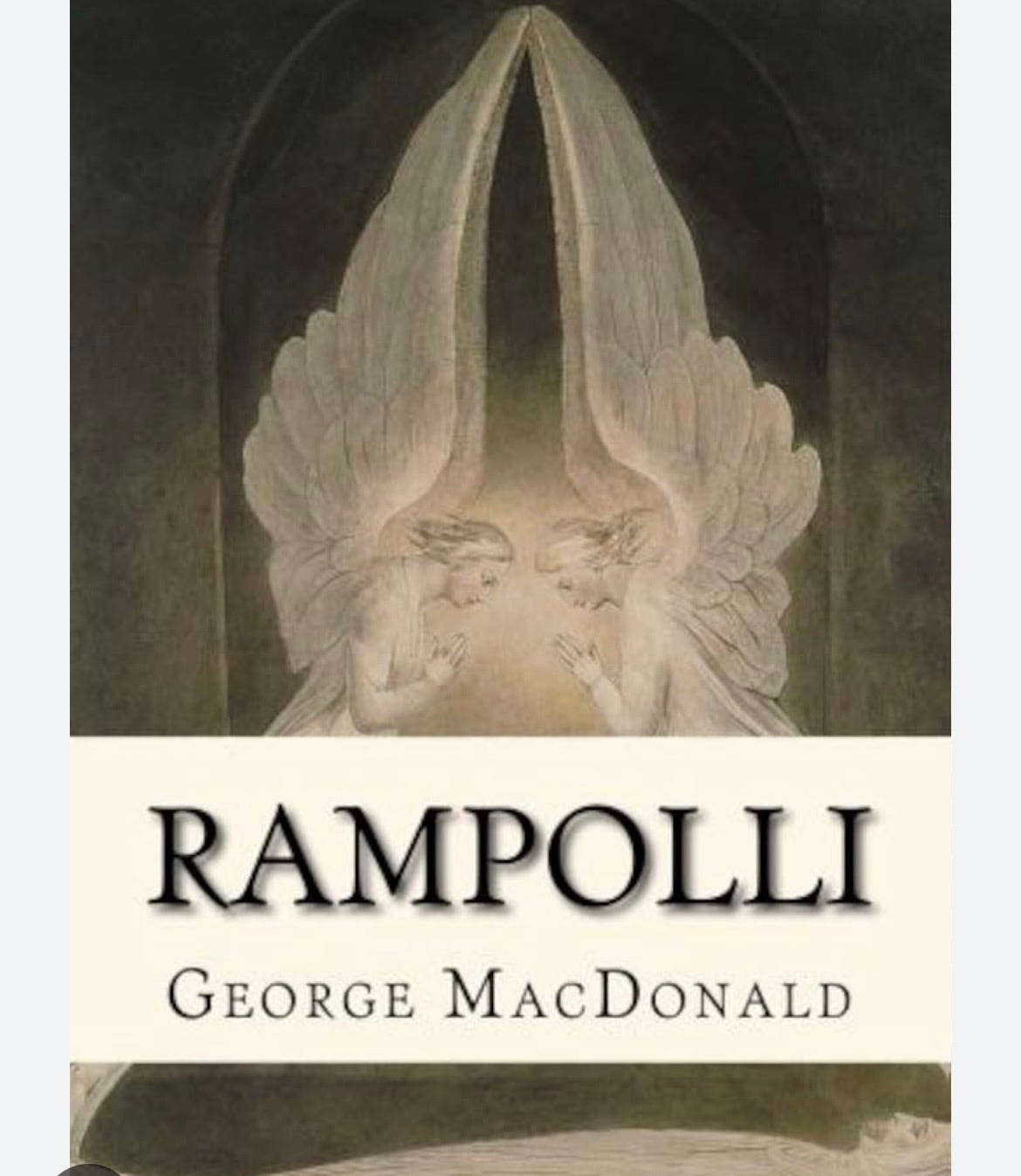
In 1897, George MacDonald translated the poem “Hymns to the Night” which can be crudely summarized thus: death is a doorway for lovers’ consummation and divine union.
You can find it in GMD’s book Rampolli:
Or if you’re impatient like me, look here: https://www.george-macdonald.com/etexts/hymns_to_night.html
In this world, Novalis finds himself to be a “pilgrim / Where every pain / Zest only of pleasure…intoxicated In Love’s lap lie.”
And when he dies, “fallen asleep, l / Still may love on.”
A theme in his work is the alchemical process. He believes a soul in love is not killed by death but charged with fresh life.
“Death’s youth-giving flood;
To balsam and ather, it Changes my blood!
I live all the daytime In faith and in might:
And in holy rapture I die every night.”
~*~
As he imagines reunion with Sophie, the tears of sorrow are transfigured into holy union:
“…through the cloud I saw the glorified face of my beloved. In her eyes eternity reposed. I laid hold of her hands, and the tears became a sparkling bond that could not be broken. Into the distance swept by, like a tempest, thousands of years. On her neck I welcomed the new life with ecstatic tears.”
Then Novalis gives thanks to God for eternal life, describing the life and death of Jesus Christ, and how he rose again!
“Uplifted is the stone,
And all mankind is risen;
We all remain thine own.
And vanished is our prison.
All troubles flee away
Before thy golden cup;
For Earth nor Life can stay
When with our Lord we sup.”
~*~
Sublime!
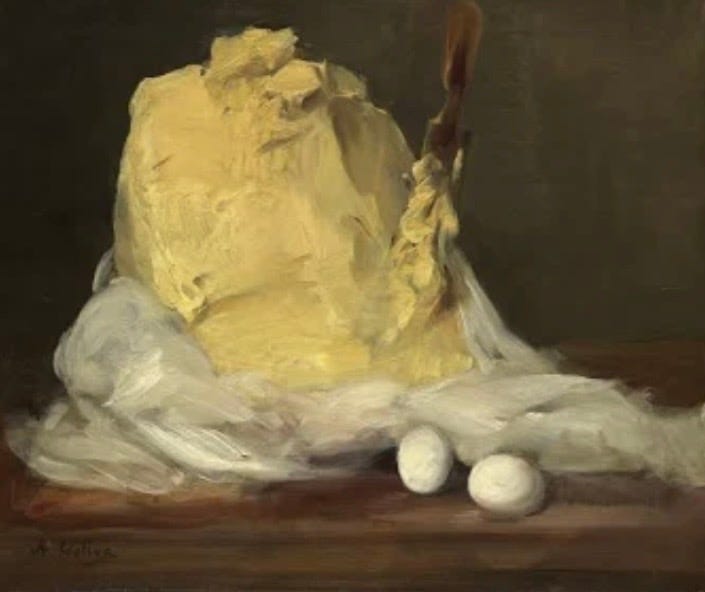
Mound of Butter by Antoine Vollon
***
I’ll leave you with a teaser for my next post (solely dedicated to the unfinished novel by Novalis).
:-)
Here is an excerpt:
“…Holy kindness deeply swelling,
In blest contemplation buried,
Heaven in the soul is dwelling
With a cloudless breast;
In our raiment long and flowing
Through spring-meadows are we carried,
Where rude winds are never blowing,
In this land of perfect rest.
*
Pleasing lure of midnight hours
Quiet sphere of hidden powers,
Rapture of mysterious pleasure,
These alone our prize;
Ours alone that highest measure,
Where ourselves in streamlets pouring,
Then in dew-drops upward soaring,
Drink we as we flow or rise.
*
First with us grew life from love;
Closely like the elements
Do we mangle Being’s waves,
Foaming heart with heart.
Hotly separate the waves,
For the strife of elements
Is the highest life of love,
And the very heart of hearts.
*
Whispered talk of gentle wishes
Hear we only, we are gazing
Ever into eyes transfigured,
Tasting nought but mouth and kiss;
All that we are only touching,
Change to balmy fruits and glowing,
Change to bosoms soft and tender,
Offerings to daring bliss.
*
The desire is ever springing,
On the loved one to be clinging,
Round him all our spirit flinging,
One with him to be,—
Ardent impulse ever heeding
To consume in turn each other,
Only nourished, only feeding
On each other’s ecstasy.
*
So in love and lofty rapture
Are we evermore abiding,
Since that lurid life subsiding,
In the day grew pale;
Since the pyre its sparkles scattered,
And the sod above us sinking,
From around the spirit shrinking
Melted then the earthly veil…”
MOUND OF BUTTER. 💛